DriveNets is taking part in a new solution validation effort with AMD and VAST Data that tackles one of AI’s most pressing challenges, optimizing the performance and cost of AI inference infrastructure. The effort combines next-generation AMD compute, DriveNets AI Fabric, and the VAST AI Operating System into a unified AI factory blueprint, optimized across the full stack rather than tuning one component at a time.
This effort represents much more than a routine technology partnership. It signals an essential industry transition, moving away from isolated vendor elements or a single end-to-end vendor solution to a multi-vendor environment with full-stack optimization across compute, storage, networking and more.
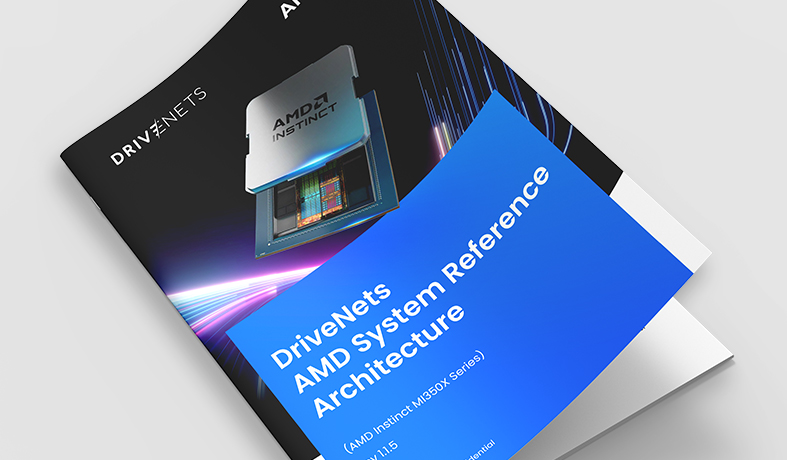
AMD and DriveNets Reference Architecture
DownloadWhy storage and networking must be co-optimized
In modern AI inference, especially multi-turn conversational workloads where prompts grow with every turn, compute is only as effective as the context feeding it. This is where storage and networking become critical factors.
Many of today’s AI environments were designed for training-centric workflows and treat storage and networking as separate silos. When a model needs to fetch context or query a vector database, it encounters latency across these fragmented layers. When storage lags, or when the network drops packets trying to deliver that data, everything downstream waits.
By tightly coupling the VAST AI Operating System with the lossless DriveNets AI Fabric, we fundamentally transform how data moves to the compute layer:
- The Network (DriveNets): Provides the lossless, high-performance fabric that guarantees data packets are never dropped or delayed. Built on open Ethernet, it optimizes storage transfers (like NVMe-oF) and keeps the cluster tightly synchronized.
- The Storage (VAST Data): Unifies storage, database, and AI services. It serves as a shared, persistent cache tier across the fabric, giving every GPU node instant access to context across the entire cluster.
- The Compute (AMD): AMD Instinct GPUs deliver the raw horsepower and HBM base capability, but now they are constantly fed.
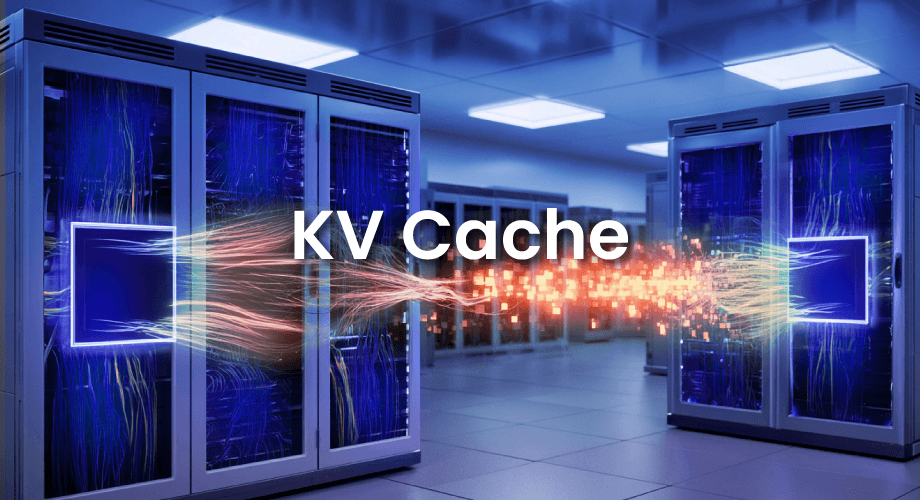
Rather than letting GPUs stall while fetching massive context or wasting cycles recomputing KV caches that could simply be retrieved, VAST, AMD and DriveNets co-optimize the entire data movement path. By tuning VAST’s intelligent data engine with DriveNets’ lossless Ethernet transport, data flows directly to compute without latency or packet loss, the cluster stays perfectly synchronized, and KV cache offloading happens seamlessly in the background. This maximizes token generation and cluster throughput across every stage of inference.
Full-stack optimization offers real results
The joint architecture between DriveNets, AMD, and VAST Data illustrates exactly what becomes possible when an AI factory is built using best-in-class technologies across the entire stack. It shows why optimizing every component in harmony is essential to maximizing AI cluster performance.
By validating compute, intelligent data services, and lossless networking fabrics together as a single open ecosystem, this collaboration directly targets known system inference bottlenecks and delivers measurable performance gains.
- 3X Faster Time to First Token (TTFT) for large-scale inference workloads.
- 3.7X Higher Token Throughput for agentic AI workloads such as AI coding, long-document Q&A, and multi-turn conversational AI.
Crucially, these performance improvements are achieved without locking customers into a rigid, single-vendor silo. Cluster builders now have the flexibility to build AI infrastructure using the exact technologies that meet their unique requirements. As noted in the announcement, this collaboration proves that an open ecosystem can bring together best-in-class networking, accelerated computing and intelligent data infrastructure to successfully power the next generation of AI factories.
Summary
The next phase of AI will reward those that optimize their entire AI cluster. The most expensive idle asset in AI today is a GPU waiting on data, and no amount of compute budget can fix a cluster bottlenecked by data starvation.
Ultimately, cross-vendor full-stack optimization, as demonstrated by the DriveNets, AMD and VAST Data collaboration, provides the most complete blueprint for large-scale AI inference infrastructure. It delivers proven performance gains without locking organizations into a single vendor’s stack.
Key Takeaways
- Eliminating GPU Data Starvation: Purchasing faster GPUs is insufficient if storage and networking are fragmented; expensive GPUs stall and sit idle when waiting for context during inference.
- Lossless Multi-Vendor Architecture: DriveNets (lossless open Ethernet), VAST Data (unified storage & cache tier), and AMD (Instinct GPUs) provide a blueprint for a multi-vendor, full-stack optimized AI factory.
- 3X Faster Time to First Token (TTFT): Co-optimizing data movement directly reduces initial response latency for large-scale AI inference workloads.
- 3.7X Higher Token Throughput: Synchronized cluster networking and background KV cache offloading significantly boost output for agentic AI tasks like coding and multi-turn conversations.
- Open Ecosystem vs. Vendor Lock-In: Organizations achieve maximum cluster efficiency without being trapped in rigid, single-vendor proprietary stacks.
Frequently Asked Questions
What performance gains are achieved by co-optimizing compute, storage, and networking in AI inference infrastructure?
Co-optimizing compute, storage, and networking delivers 3X faster Time to First Token (TTFT) and 3.7X higher token throughput for large-scale inference workloads[cite: 1]. Unifying AMD Instinct GPUs, VAST Data AI Operating System, and DriveNets AI Fabric eliminates data movement bottlenecks in agentic AI tasks like coding and multi-turn conversations without single-vendor lock-in[cite: 1].
Why do high-performance GPUs sit idle during AI inference workloads?
High-performance GPUs experience idle time during AI inference because fragmented, training-centric storage and network layers cause latency during context retrieval[cite: 1]. When multi-turn prompts or vector queries stall across isolated vendor silos, compute nodes suffer data starvation[cite: 1]. Co-optimizing VAST Data storage, DriveNets lossless Ethernet, and AMD compute resolves these critical system bottlenecks[cite: 1].
How does DriveNets AI Fabric optimize data movement across the AI stack?
DriveNets AI Fabric provides a lossless, high-performance open Ethernet transport that prevents packet loss and delays during NVMe-oF storage transfers[cite: 1]. By tightly coupling with the VAST AI Operating System and AMD Instinct GPUs, it ensures synchronized cluster communication, continuous data streaming to compute nodes, and seamless background KV cache offloading[cite: 1].