
- How can MSOs/cable operators change the way they build their networks
- A very messy network architecture
- Key concepts in the MSO network modernization process
- Want to discuss this further?
Something is changing in MSO’s network architecture. While we read a lot about DOCSIS 4.0, there are additional, significant changes in how MSOs build their infrastructure. Let’s try to understand what drives multiple systems operators (MSOs) / cable operators to make this change.
How can MSOs/cable operators change the way they build their networks
For these operators, one thing shared in common is that they have experienced exponential growth in traffic across their networks. This is driven by over-the-top (OTT) unicast programming, as well as by remote and work-from-home initiatives.
The Four Dimensions of Network Convergence
To learn more download the white paperThis is shaking things up. The basic hybrid fiber-coaxial (HFC) network was built with analog video in mind, but it evolved over years to accommodate the pivot from video towards data. In recent years it has become a data-focused network, in which most of the video (on demand, but also linear programming) is running on top of the data network. The growing demand in the access network is handled with the evolution of DOCSIS (Data Over Cable Service Interface Specification); DOCSIS 4.0 technology supports up to an impressive 10Gbps in the downstream and an even more impressive 6Gbps in the upstream, as well as a low-latency service. This enables MSOs to compete with a full-fiber, xPON-based telco offering, with on-par performance, service breadth, and power consumption.
A very messy network architecture
But the story does not end in the HFC. Some operators run multiple-generation DOCSIS, as well as some xPON service across their network, which yields a mix of aggregation nodes, edge sites, termination systems, and core routers. In some cases there is a single instance of each function per access technology/generation. Bottom line – it’s a very messy architecture.
MSOs are becoming louder and louder about simplifying their network architecture. As such, many are calling for disaggregation and virtualization of multiple network functions in order to make their network simpler to plan, build, and manage.
Key concepts in the MSO network modernization process
The three main concepts of the MSO modernization process, as it becomes imminent and mandatory, are disaggregation, convergence and automation.
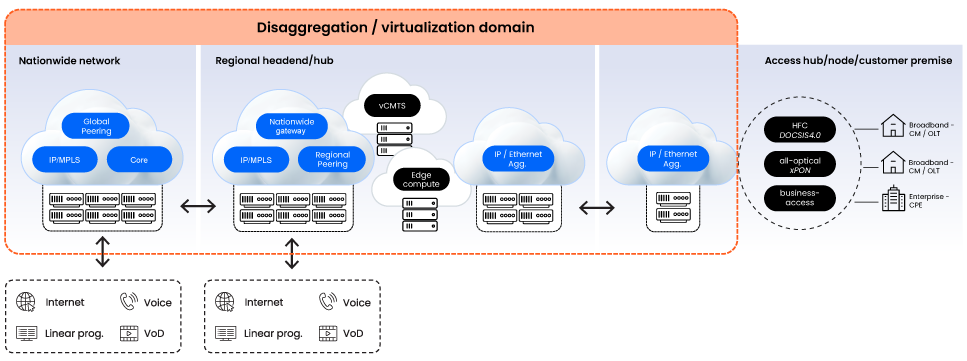
- Disaggregation: We’re talking about the disaggregation and virtualization of any network function outside the access domain (“the disaggregation domain”). This is needed in order to make the network software-centric and to create a harmonized, standard hardware infrastructure, where the real difference between most network functions is the software that runs on top of it.
- Convergence: Here we mean convergence of network domains and layers. All access technologies and generations, and all types of services, are handled by the same aggregation, edge and core functions. As a result, there are no more network silos per technology or service. Furthermore, the optical and IP layers are also converged (utilizing technologies like ZR and ZR+) to further simplify the network architecture.
- Automation: Massive automation, including (future) use of AI tools, further mitigates operational overhead.
Based on these three key concepts, the MSO network becomes a much simpler beast than the one you probably know today.
The following diagram illustrates an MSO network built according to these concepts while utilizing the DriveNets Network Cloud solution.
Want to discuss this further?
Reach out and schedule a time to talk.