Download
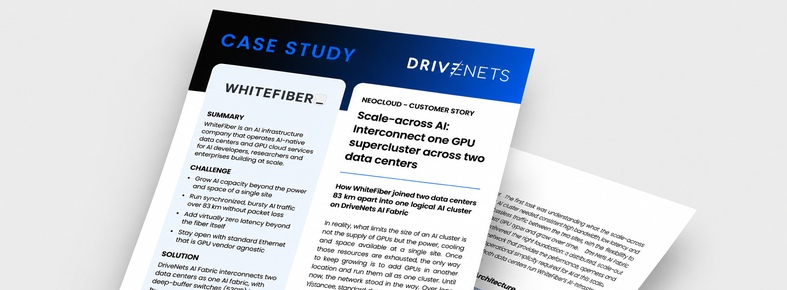
How did WhiteFiber join two data centers 83 km apart into one logical AI cluster on DriveNets AI Fabric?
In reality, what limits the size of an AI cluster is not the supply of GPUs but the power, cooling and space available at a single site. Once those resources are exhausted, the only way to keep growing is to add GPUs in another location and run them all as one cluster. Until now, the network stood in the way. Over long distances, standard data center links add latency, jitter and lost packets, and AI traffic cannot tolerate any of these. So the common belief has been that all GPUs must sit under one roof.
WhiteFiber and DriveNets set out to solve this together. The Continuum project joins two of WhiteFiber’s Georgia data centers into one AI cluster, with DriveNets AI Fabric as the network that connects them.
This case study examines WhiteFiber’s deployment of DriveNets AI Fabric across two data centers 83 km apart, the first commercial long-distance, scale-across AI networking deployment.
WhiteFiber’s Challenge
WhiteFiber builds and operates GPU clouds designed for AI. As its customers ask for larger and larger clusters, it keeps running into the same hard limit. Each site has only so much power and space. With its Continuum project, WhiteFiber took the next step and joined two separate data centers into one GPU cluster that works as a single system.
Doing this over 83 km is a hard networking challenge. Even at the speed of light, a signal needs about 0.81 ms to travel through the fiber and back, before the network equipment adds any delay. But distance is only part of the problem. AI workloads add even more stress to the network. They create sudden traffic bursts, with many GPUs sending data to the same place at the same moment. Standard interconnect solutions cannot absorb these bursts without delays or lost packets, and AI workloads cannot tolerate either. One delayed data flow can slow down the whole job. For Continuum, WhiteFiber needed a network that could meet four goals.
- Move bursts of AI traffic across 83 km without losing any packets
- Keep AI workload performance close to what a single site delivers
- Run both sites as one network, not as two separate clusters
- Use open, standard Ethernet that works with GPUs from any vendor
Why DriveNets Stood Out
Inside each data center, WhiteFiber deployed DriveNets’ production-proven Scheduled Fabric to eliminate the bottlenecks of standard Ethernet. Conventional networks rely on hash-based load balancing to pin each data flow to a single path. When two large AI flows land on the same link, they collide and slow down the whole cluster. DriveNets’ scheduled fabric avoids this by slicing traffic into cells and spraying them evenly across every available link. This removes collisions, hot spots and jitter while keeping every link fully utilized. If a link fails, the fabric reroutes traffic within microseconds, with no impact on the training job.
“We selected DriveNets AI Fabric since it has been proven to deliver the highest Ethernet-based AI connectivity in enterprise and Hyperscaler environments. That’s the type of innovation and performance we look for in the companies we work with”
Because a scheduled fabric architecture cannot stretch across WAN links, DriveNets bridges the 83 km link at the network edge using its 5301R interconnect switches. Over that distance, traditional flow hashing would be even more damaging, as a single congested fiber path can stall a distributed training run. Instead, the 5301R combines two WAN-specific capabilities.
- Dynamic per-queue-pair (QP) load balancing distributes traffic evenly across every parallel optical link rather than pinning entire flows to a single path.
- Deep High Bandwidth Memory (HBM) buffers absorb synchronized GPU bursts, giving congestion control signals (ECN and PFC) enough time to react and regulate traffic across the longer round-trip without packet loss.
Together, these two capabilities let two separate sites operate as one logical cluster, built on GPU- and NIC-agnostic open Ethernet that is ready for future accelerator generations without a network redesign.
Solution
WhiteFiber selected DriveNets AI Fabric as the network layer of WhiteFiber Continuum, joining its Atlanta and Suwanee data centers into one logical GPU supercluster. DriveNets software controls hundreds of switch ports across both sites and runs them as a single fabric.
The design has three layers. Inside each site, DriveNets 5300R leaf switches and 9300F spine switches form a scheduled Ethernet fabric that serves 256 NVIDIA H200 GPUs, each with a 400G connection. At the edge of each site, DriveNets 5301R interconnect switches with deep HBM buffers terminate the long-distance link. Between the sites, 12 dark fibers carry 170 channels of 800G ZR+ coherent optics, plugged directly into the switch ports with no separate transport equipment. The goal is simple. From the point of view of the AI workload, the link between the sites should behave like a connection inside one data center, not like a WAN hop.
Architecture details:
- Compute 512 NVIDIA H200 GPUs, 256 per site, in 8 racks per site
- Intra-site fabric: scheduled fabric Ethernet architecture using DriveNets 5300R leaf switches (8 per site) and 9300F spine switches (5 per site) with 400G optics per GPU and 800G leaf-to-spine
- Inter-site interconnect DriveNets 5301R HBM-buffered interconnect switches (10 per site) at the boundary between the site fabric and the long-distance link, with per-queue-pair load balancing across all WAN links
- Optical transport 12 dark fiber strands (6 duplex pairs) over 83 km, 170 x 800G ZR+ coherent pluggables and 136 Tbps aggregate cross-site bandwidth
- Storage WEKA NeuralMesh software-defined data platform with cross-site data mobility
- Sites Atlanta, Georgia (73 MW) and Suwanee, Georgia (26 MW)
Results
With DriveNets AI Fabric joining its two data centers, WhiteFiber validated Continuum as a production deployment and achieved the following results.
- One supercluster across two sites 512 H200 GPUs in two data centers 83 km apart operate as a single logical system rather than two separately managed environments.
- Near-zero equipment overhead the link carries 136 Tbps between sites with a round-trip latency of ~ 0.9 ms. Light alone needs about 0.81 ms to make that trip through the fiber, so the network equipment adds less than 0.1 ms.
- Lossless over distance The DriveNets HBM-buffered interconnect tier held packet loss at effectively zero across the validation window despite the synchronized bursts of distributed training.
- Same-site performance, cross-site raw RDMA bandwidth per link reached 784 Gb/s both cross-site and same-site (100%), and training throughput stayed close to same-site across strategies.
- Room to grow the fabric is GPU and NIC agnostic and AI Fabric supports clusters of up to 32,000 GPUs, so the next constraint is how many sites WhiteFiber chooses to wire together, not the architecture.
| Link | Bandwidth [Gb/s] |
|---|---|
| Same-site | 784 |
| Cross-site | 784 |
| Configuration | Cross-site throughput as % of same-site |
|---|---|
| 8 + 8 nodes | 100% |
| 16 + 16 nodes | 97% |
| 30 + 30 nodes | 96% |
Summary
Until now, a NeoCloud that ran out of room at one site had nowhere to grow. Over a long-distance link, standard networks add latency, jitter and packet loss, and distributed training slows down or stalls. So the clusters stayed under one roof. DriveNets AI Fabric gave WhiteFiber the network to break that limit. A scheduled Ethernet fabric inside each data center, deep-buffer interconnect switches at the edge, and fine-grained load balancing across the long-distance link work together to keep GPUs busy across 83 km. As a result, WhiteFiber Continuum runs two data centers as one logical supercluster, with cross-site training throughput close to same-site levels. Physical distance is no longer the barrier to scaling AI.
Frequently Asked Questions
Can two data centers be connected as one AI cluster?
Yes. WhiteFiber joined two data centers in Atlanta and Suwanee, Georgia, 83 km apart, into one logical GPU supercluster of 512 NVIDIA H200 GPUs, 256 per site, using DriveNets AI Fabric. The two sites operate as a single logical system rather than two separately managed environments, and cross-site training throughput stayed at 96% to 100% of same-site.
How much latency does a long-distance link between data centers add?
The 83 km link between the two data centers adds less than 0.1 ms of latency beyond the fiber itself. Round-trip latency is about 0.9 ms, and light alone needs about 0.81 ms to travel through the fiber and back. The link carries 136 Tbps between sites over 12 dark fibers.
How do you prevent packet loss on AI traffic across long-distance links?
Deep buffers and fine-grained load balancing prevent packet loss. DriveNets 5301R interconnect switches use deep High Bandwidth Memory buffers to absorb synchronized GPU bursts, giving ECN and PFC congestion control enough time to react over the longer round trip. Dynamic per-queue-pair load balancing spreads traffic evenly across every parallel optical link instead of pinning flows to one path.