- What the AI 100 measures, and why it is not a product award
- The decision we made in 2025: transform, not optimize
- The DriveNets Intelligence Factory: one system every team plugs into
- The Knowledge Mesh: when the company knows what the company knows
- Spending on AI the smart way
- What comes next
- Why this matters for the AI networks we build
TL;DR
DriveNets’ AI 100 recognition reflects both the AI networks it builds and how it operates internally. Its Intelligence Factory and Knowledge Mesh bring AI workflows and shared knowledge to teams across the company. The next goal is AI-Only: a model where the Factory builds to specification while people set direction, judge quality and own outcomes.
DriveNets has been named to the inaugural AI 100, which Newcomer describes as the definitive ranking of the top 100 private AI companies in the world. The full ranking is published at https://ai100.newcomer.co/.
Most people who know DriveNets know us for the networks we build for AI: the AI Fabric that keeps GPUs computing instead of waiting for data. We write about new AI use cases and features almost every week. This post is about something we rarely talk about: how we run DriveNets itself as an AI-first company, and the goal we’ve set for ourselves, which we call AI-Only.
What the AI 100 measures, and why it is not a product award
The inaugural AI 100 evaluated nominated companies and recognized category leaders across four weighted factors:
- Market leadership (35%)
- Estimated valuation (30%)
- Operating metrics (20%)
- People & culture (15%)
Look at that list again. Two of the four factors, operating metrics and people & culture, are about how a company runs, not what it sells. The AI 100 is a ranking of AI companies, and in 2026 the test of an AI company is no longer only whether it ships AI. It is whether it operates like one.
The decision we made in 2025: transform, not optimize
We made a choice: instead of adding AI tools to the way we already work, we would redesign the work itself around AI. We committed to becoming an AI-first company and put a dedicated leader and team in charge. Not a tooling initiative. Not a pilot. A transformation with named owners and a weekly leadership forum to remove adoption barriers. An enablement team from R&D and IT defines a secure, company-wide architecture for agents that work with company data. Every function has AI champions, and every all-hands has an AI spotlight so everyone can see the progress.
And yes….transformation is (most times) uncomfortable because it changes how people think and work, not just which tools they open in the morning, so we had to adapt as well.
The DriveNets Intelligence Factory: one system every team plugs into
We call the result the DriveNets Intelligence Factory. It is one system, not a collection of tools. Every team starts work through the same door: an intent goes in, whether a spec, a fix or an improvement, and a delivered outcome comes out. In between, an orchestrator runs the team’s workflow end to end, with gates that pause and route questions to the right owner. Agents run in the cloud, in parallel, and keep working after people close their laptops.
A marketplace publishes certified skills and plugins so that what worked for one team is the starting point for the next. A model router chooses the right model for each class of task, based on our own evaluations rather than habit. And a self-improvement engine scores every run, proposes better skills, prompts and routing, and lets humans approve what ships.
R&D was the first user of the Factory, but it was never meant to be the only one. Hardware design, supply chain, sales, finance, HR, IT, support, marketing and product each run their own workflows through the Factory, and every skill one team publishes becomes a starting point for the others. The principle is the same one we apply to our full stack networking solutions for AI infrastructure: optimize the system, not only the component.
The Knowledge Mesh: when the company knows what the company knows
An agent is only as good as its context. Early on we learned that the biggest barrier to useful AI at work is not model quality. It is that the knowledge a model needs lives in one person’s head, or in five documents that disagree with each other.
Our answer is the DriveNets Knowledge Mesh. Each team compiles its own wiki, with one approved source per topic, and people and agents can read them all in one place. Every employee has an AI assistant that reads the mesh, so it always has up-to-date context. When an agent updates one wiki, the whole company stays in sync. Teams unlocked knowledge that used to be out of reach, mapped sources no one had ever listed, and replaced “ask around” with “ask the mesh.”
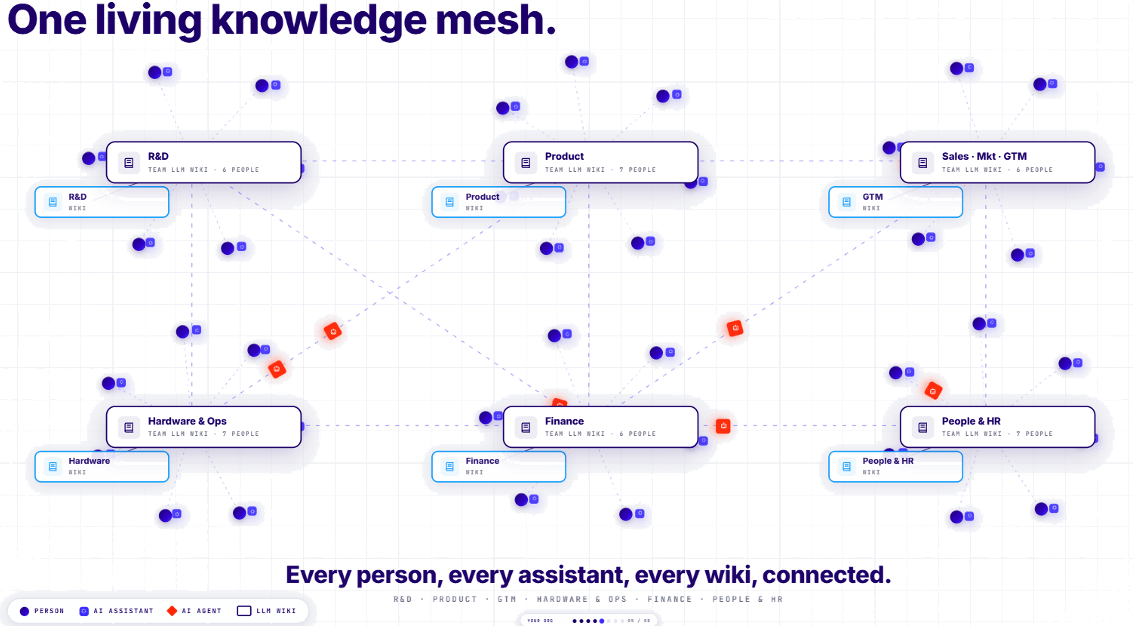
The real payoff is economic. Every new wiki makes the next answer cheaper, for everyone. Knowledge stops being a cost and starts compounding.
Spending on AI the smart way
An AI-first company treats intelligence like a factory treats energy: pay for what you use, measure it, and let the people doing the work own it. We dropped flat subscriptions and moved to usage-based consumption. Every employee gets a default budget and can see their own usage in real time. And we were clear: the budget is a starting point, not a cap. If AI helps someone get more done, we want them using more of it.
Two practices make this work:
- LLM routing: people just describe the task and the Factory picks the model, based on our own evaluations. They can still override it.
- Evals: tests that check whether the AI did a job well, like a grading rubric. Each team writes these tests for the AI tasks it owns. A system can only improve itself if it has a score to beat, and evals provide that score. One early evaluation showed that for a common code-review task, making the AI “think harder” (which costs more) barely improved the results, while switching to cheaper, smaller models missed too many bugs. So the best value was in the middle, and that single finding changed the default setting for everyone. Multiply it across every skill in every team and the Factory improves itself.
What comes next
AI-First is where we are. AI-Only is where we’re going, and it’s easy to misread, so let’s be precise.
AI-Only does not mean a company without people. It means the Factory builds to spec, and people do what only people can do: decide what should exist, design the system that builds it, judge quality, own outcomes and coach others. Today, engineers still spend a large share of their time steering agents by hand, one prompt and one session at a time. We want to cut that sharply. In the AI-Only model, product managers describe most features, the Factory builds them, and people step in only for what is risky or new. Engineers spend their time improving the Factory and incubating new products.
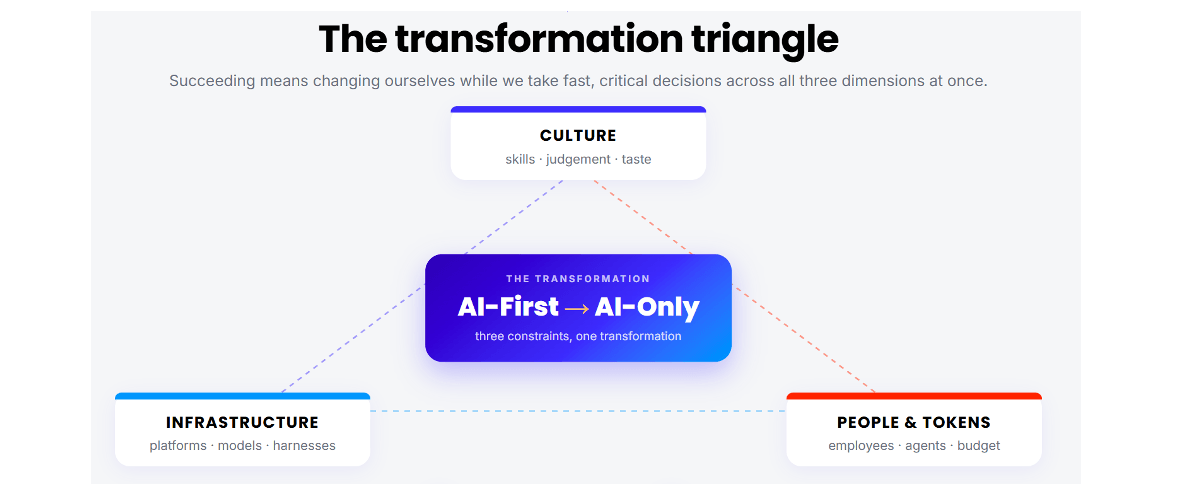
We describe this transformation as a triangle: culture (skills, judgment, taste), infrastructure (platforms, models, harnesses) and people and tokens (employees, agents and the AI usage budget). You can’t move one corner without moving the other two. Our advice to anyone starting the same journey: Buying tools moves one corner. End-to-end transformation moves all three.
Why this matters for the AI networks we build
There is a reason the two stories, the network for AI (AI Fabric) and the company run on AI, belong in the same post. Both are systems problems. A GPU cluster underperforms when any layer (compute, storage, fabric or software) is optimized on its own. A company underperforms the same way. An AI-first operating model is how we intend to keep shipping AI networking as fast as our customers build their AI infrastructure. For us, the AI 100 recognition is as much about that operating model as about the solutions and products we build.
About the author
With over 20 years of extensive managerial and hands-on experience in the telecommunications and mobile industries, Tzvika Naveh is Director of Product Marketing at DriveNets. He supports the global expansion of DriveNets Networks Cloud solution, collaborating with Product Management on strategy and planning. Previously he served as Marketing Director for the Cloud & OSS Product Group at Amdocs. He also served as a Director of Product Marketing at Ceragon Networks. Tzvika holds an MBA from the Israeli Open-University and a B.Sc. in Computer Science Engineering from Ben-Gurion University.
Key takeaways
- Redesigning Work Around AI: DriveNets’ AI-first approach focuses on transforming how teams work, with dedicated owners, AI champions and shared infrastructure.
- One Intelligence Factory: The DriveNets Intelligence Factory brings agents, workflows, certified skills and model selection into a shared system that teams across the company can use.
- Shared Knowledge, Better Context: The DriveNets Knowledge Mesh gives employees and AI agents access to approved team knowledge, helping them work with consistent, up-to-date company context.
- Measuring AI Value: Usage-based budgets, task-specific model selection and evaluations help teams balance AI cost and quality while continuously improving their workflows.
- Moving Toward AI-Only: DriveNets’ goal is for the Factory to build to specification while people define direction, judge quality, own outcomes and improve the system.
Frequently Asked Questions
What does AI-first mean at DriveNets?
At DriveNets, being AI-first means redesigning work around AI rather than simply adding AI tools to existing processes. The DriveNets Intelligence Factory brings together agents, workflows, shared skills and model selection, while people set direction, review quality and own outcomes.
How does the DriveNets Knowledge Mesh support AI across the company?
The DriveNets Knowledge Mesh brings team knowledge into shared wikis, with one approved source per topic. Employees and AI agents can access this knowledge in one place, helping assistants work with current company context and enabling teams to reuse knowledge across the organization.
What is the difference between AI-first and AI-Only at DriveNets?
AI-first describes how DriveNets operates today. AI-Only is its goal: having the Intelligence Factory build to specification while people decide what should exist, design and improve the system, judge quality and own outcomes. It does not mean a company without people.