- Why is fiber speed a hard limit for distributed AI workloads?
- Deeper dive into WhiteFiber’s new AI fabric
- How do deep buffers give ECN the time it needs?
- What is the next generation of AI infrastructure?
To overcome these local constraints, builders must tap into resources in other locations. However, when we suggest splitting an AI cluster across geographically separated data centers, customers frequently point out that network physics and latency present major hurdles. Nobody can change the speed of light, but there is a viable way to maintain AI-grade performance over long distances. DriveNets and WhiteFiber have launched the first commercial deployment of long-distance, scale-across AI networking.
Why is fiber speed a hard limit for distributed AI workloads?
To understand why this deployment is a challenge, we have to look at the actual numbers. Light travels through optical fiber at roughly 200K kilometers per second. Across a distance of 83 kilometers (in this use case), the physical transit time of a signal going back and forth is roughly 0.83 milliseconds.
In traditional networking, running highly synchronized AI training workloads over this distance is considered impossible. AI workloads generate massive, synchronized traffic bursts. Standard Data Center Interconnect links rely on traditional packet forwarding and simply cannot handle these bursts without experiencing jitter or packet loss.
Even a tiny fraction of packet loss during an AI training run stalls expensive GPU cycles and causes massive delays. Because of this, the consensus has always been that all your GPUs must sit under one roof.
Until now.
Scaling AI Clusters Across Multi-Site Deployments
DownloadDeeper dive into WhiteFiber’s new AI fabric
Through this WhiteFiber deployment, DriveNets has broken this paradigm and proved that geographic distance does not have to restrict AI infrastructure scaling.
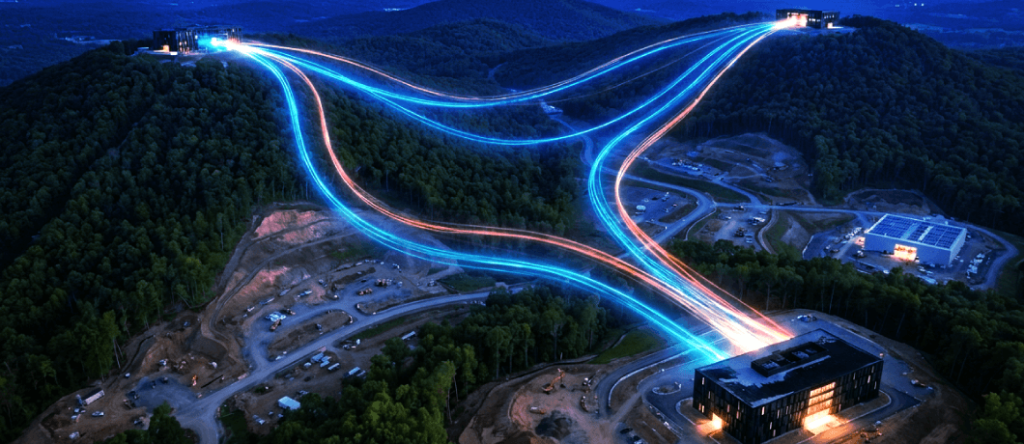
Using DriveNets AI Fabric, WhiteFiber successfully connected two separate data centers located 83 km apart into a single logical GPU supercluster. This setup operates as one unified system rather than two separate environments. The validation results are impressive.
Validated bandwidth reached a massive 136 Tbps of aggregate unidirectional cross-site bandwidth, while the guaranteed latency remained ultra-low at 0.9 milliseconds, which means the actual networking equipment overhead added virtually zero delay on top of the physical speed of light through the fiber.
WhiteFiber’s latest announcement builds on this deployment with WhiteFiber Continuum, which brings two data centers 83 km apart together as one logical AI supercluster. With DriveNets AI Fabric providing the networking foundation, Continuum demonstrates how AI infrastructure can expand beyond a single site’s power and space limits.
Raw network performance is only half the story. The real test is whether AI training jobs run as well across this distance as they would in a single site. We benchmarked training workloads across the two locations, measuring step time and compute throughput against same-site performance. Across different training strategies, from large-scale pretraining to fine-tuning to the most communication-heavy parallelism approach, throughput stayed close to same-site levels. These results show the fabric holds up under the same synchronized, bursty traffic that made long-distance AI clusters seem impossible before.
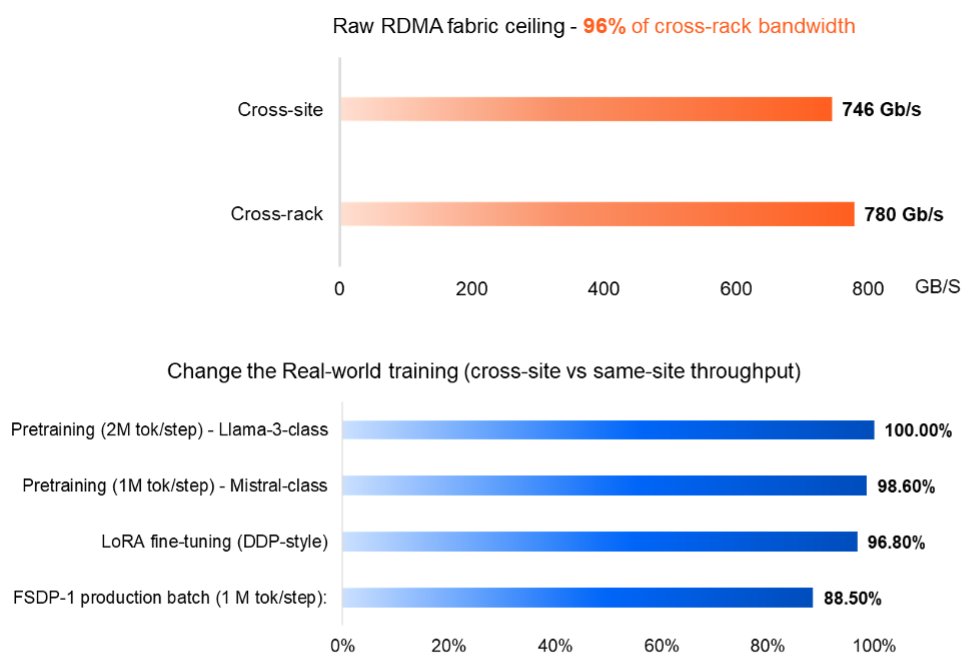
Cross-site vs same-site benchmarking results
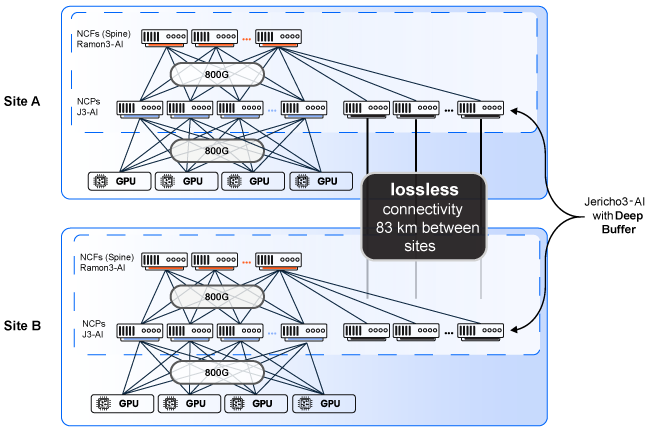
Scale across topology
How do deep buffers give ECN the time it needs?
Making a distributed cluster perform as if it were in a single data center requires a careful separation between intra-data center networking and inter-data center connectivity.
While DriveNets cell-based scheduled fabric connectivity offers industry-leading performance inside each individual data center, extending that scheduled fabric connectivity over a long-distance WAN link is architecturally impossible. Instead, DriveNets uses different networking features to bridge the two data centers.
- Deep HBM Buffer: extra-capable interconnect switches (5301R) are deployed at the edge of the data centers. Standard buffer switches work fine for short connections inside a data center, but they fail across long distances. When massive AI traffic bursts occur, the deep High Bandwidth Memory buffers in the interconnect switches absorb them. This buffer capacity gives proactive congestion control protocols, specifically Explicit Congestion Notification (ECN) and Priority-based Flow Control (PFC), the reaction time they need to prevent packet loss over the increased round-trip time (RTT).
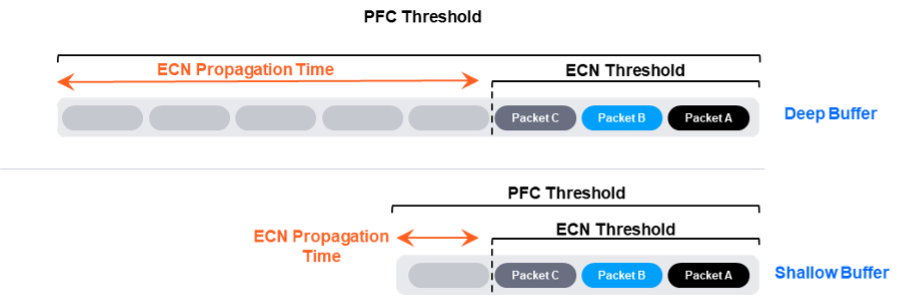
- Granular Per-Queue Pair Load Balancing is implemented across the long-distance links. Instead of relying on traditional coarse load-balancing methods that can cause traffic bottlenecks, this granular strategy distributes traffic dynamically and evenly. This maximizes multi-path utilization across all connected physical WAN links simultaneously.
This combination of deep buffers, tweaked congestion management parameters, and precise load balancing delivers the lossless Ethernet connectivity required to keep GPU utilization exceptionally high across long distances.
What is the next generation of AI infrastructure?
Power and space limitations often stall AI infrastructure growth, but they no longer have to. This deployment brings the concept of “scale-across” to life, seamlessly connecting two remote data centers to perform as a single, high-performance supercluster.
Together, WhiteFiber and DriveNets are proving that physical distance is no longer a barrier. By moving from single-site clusters to a distributed architecture, AI builders can now design next-generation superclusters without being limited by local resource constraints.
Key takeaways
- First Commercial Scale-Across Deployment
DriveNets and WhiteFiber have launched the industry’s first commercial long-distance, scale-across AI networking architecture to bypass local data center power, cooling, and space constraints. The fabric seamlessly unifies two distinct data centers located 83 kilometers apart into a single, cohesive logical GPU supercluster. - Near-Zero Hardware Latency Overhead
The deployment successfully validated a massive 136 Tbps of aggregate unidirectional cross-site bandwidth while maintaining an ultra-low guaranteed latency of 0.9 milliseconds. This achievement proves that the active networking equipment adds virtually zero delay on top of the physical speed of light traveling through the fiber. - Parity with Same-Site Performance
Real-world benchmarks across multiple training strategies—including large-scale pretraining, fine-tuning, and communication-heavy parallelism—showed that distributed throughput stays extremely close to same-site performance levels. This shatters the traditional infrastructure consensus that all GPUs must be located under one roof to avoid stalling expensive compute cycles. - Innovative Lossless Architecture
To bridge the long-distance links without packet loss, the network relies on extra-capable 5301R interconnect switches equipped with deep High Bandwidth Memory (HBM) buffers. These deep buffers absorb massive, synchronized traffic bursts, giving proactive congestion control protocols (ECN and PFC) the necessary reaction time over increased round-trip times, while granular per-queue pair load balancing ensures multi-path WAN link utilization.
Frequently Asked Questions
How does the DriveNets and WhiteFiber deployment overcome the geographic distance limitations of AI clusters?
DriveNets and WhiteFiber connected two data centers 83 kilometers apart into a single logical GPU supercluster using DriveNets AI Fabric. This long-distance scale-across architecture validated 136 Tbps of aggregate unidirectional cross-site bandwidth and maintained an ultra-low latency of 0.9 milliseconds, ensuring performance levels remain close to same-site training benchmarks.
What role do deep buffers play in maintaining lossless Ethernet connectivity across long distances?
Deep High Bandwidth Memory (HBM) buffers in DriveNets 5301R interconnect switches absorb massive, synchronized AI traffic bursts at the data center edge. This extended capacity provides proactive congestion control protocols, specifically ECN and PFC, the critical reaction time needed to prevent packet loss over increased round-trip times.
How does Granular Per-Queue Pair Load Balancing improve distributed AI cluster performance?
Granular Per-Queue Pair Load Balancing eliminates traditional traffic bottlenecks by distributing AI network traffic dynamically and evenly across long-distance links. This precise strategy maximizes multi-path utilization across all connected physical WAN links simultaneously, maintaining the high GPU utilization required for seamless cross-site AI training.