Ra’anana, Israel – July 9, 2026 – DriveNets, a leader in large-scale networking solutions, ttoday announced the industry’s first commercial deployment of an AI supercluster with long-distance scale-across AI networking. As part of Project Redwood announced today by WhiteFiber (NASDAQ: WYFI), a leading provider of AI infrastructure solutions, the DriveNets AI Fabric connects two WhiteFiber H200 GPU clusters located 52 miles apart into a single logical GPU supercluster, validated at 111.2 Tbps of bandwidth with 0.9ms of guaranteed latency. While scale-across architecture has been widely discussed across the industry, DriveNets is the first to move from concept to a live, commercially deployed network, proven at production scale rather than in a lab.
Addressing the AI power constraint with Scale-Across networking
AI infrastructure buildouts are increasingly constrained not by compute, but by the power and space available at a single site. Scale-across architecture removes that constraint; instead of being capped by one facility’s power envelope, AI builders can extend their cluster to a remote site and operate the distributed GPUs as one unified system, not two separate environments. This allows larger clusters, greater resiliency, and the freedom to build where power is available, without compromising performance.
Stretching a cluster across distance is a harder networking problem than simply running a cable between two sites. The links connecting remote locations typically carry less bandwidth than the fabric inside either facility, leaving little room to absorb sudden bursts of traffic before they turn into congestion. AI training compounds the challenge: rather than many small, steady flows, it generates a handful of extremely large ones that arrive in synchronized bursts, a pattern the load-balancing and buffering approaches built for conventional data centers were not designed to handle. Without a fabric engineered to absorb those bursts and manage congestion in real time, latency spikes and packet loss follow, and a stalled job leaves GPUs on both sides of the cluster sitting idle. Solving this at long distance, without giving up performance, is what makes scale-across architecture – and the switching, buffering and congestion-management technology behind it – so critical to the next phase of AI infrastructure growth.
The first commercially deployed Scale-Across solution
WhiteFiber’s Project Redwood links two geographically separated GPU clusters into a single logical GPU supercluster with the DriveNets AI Fabric solution providing the high-performance network connecting both sites.
“Power availability can be a major limit to AI infrastructure growth, but with this proven deployment, it no longer has to be,” said Ido Susan, co-founder and CEO of DriveNets.
“Together with WhiteFiber, we have taken scale-across from concept to commercial reality, showing that two remote data centers can perform as a single high-performance supercluster. This is how we expect many next-generation AI infrastructures to be built.”
“DriveNets’ AI Fabric was critical to proving that Project Redwood could deliver the performance and reliability of a single-site cluster across two locations,” said Sam Tabar, CEO of WhiteFiber. “This milestone shows that geography no longer has to limit the scale of the AI infrastructure we build.”
As part of the validation process, performance between GPU racks within a single site was compared with performance between GPU racks across two sites, with one GPU rack located at the primary site and the other at the remote site. Additional details about the validation methodology and results are available in DriveNets’ white paper.
Lossless performance beyond the data center walls
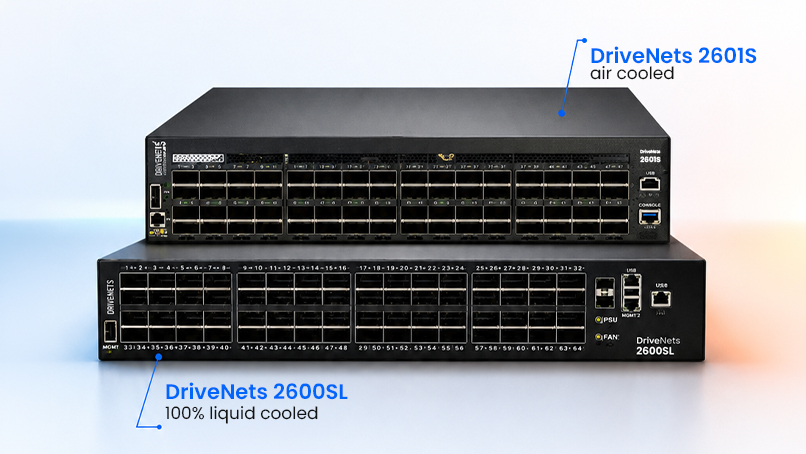
Traditional Data Center Interconnect links were not designed for AI workloads, which generate traffic bursts that cannot tolerate jitter or packet loss. Even small losses during training can delay job completion and waste expensive GPU cycles. DriveNets’ 9300F ,5300R and 5301R switches, powered by its Fabric Scheduled Ethernet (FSE) technology, extend the AI fabric beyond a single data center using cell-based load balancing, end-to-end Virtual Output Queuing (VOQ), and deep-buffer interconnect that absorb AI traffic bursts before they cause congestion. The result is predictable, lossless connectivity between sites that keeps GPU utilization high, as if the entire cluster were under one roof. That combination of the industry’s highest performance and zero packet loss is not incidental but is a direct result of DriveNets’ purpose-built architecture, and it is why DriveNets AI Fabric is the best available networking solution for geographically distributed AI clusters. To learn more about scaling AI clusters across multi-site deployments, visit https://www.drivenets.com
About DriveNets
DriveNets is a leader in large-scale networking solutions for AI infrastructure and service providers. The company’s disaggregated networking architecture transforms the economics of large-scale infrastructures while maximizing performance, utilization, and operational efficiency. Its high-performance AI fabric maximizes GPU utilization and accelerates deployments by optimizing the AI stack end-to-end, resulting in higher tokens-per-second and lower cost-per-token. DriveNets’ solutions power production networks for global tier-1 operators like AT&T and Comcast, and scale multi-vendor AI infrastructures at foundation model labs, NeoClouds, and enterprises. Learn more at https://www.drivenets.com
Frequently Asked Questions
What is the capacity and performance of DriveNets’ long-distance scale-across AI networking deployment?
DriveNets’ scale-across AI networking fabric delivers 111.2 Tbps of validated bandwidth with 0.9 ms of guaranteed latency. Implemented as part of Project Redwood, this solution successfully connects two distinct WhiteFiber H200 GPU clusters located 52 miles apart into a single logical supercluster, achieving high-performance, long-distance interconnectivity for production-scale AI workloads.
How does scale-across networking address the physical constraints of AI infrastructure buildouts?
Scale-across networking resolves site-specific power and space constraints by allowing AI clusters to expand to geographically remote locations. Instead of being capped by a single facility’s power envelope, operators can distribute GPUs across separate data centers while managing them as a single, unified system without sacrificing high-performance capabilities.
What technologies enable DriveNets AI Fabric to maintain lossless performance over long distances?
DriveNets AI Fabric achieves predictable, lossless connectivity using 9300F, 5300R, and 5301R switches powered by Fabric Scheduled Ethernet technology. This architecture utilizes cell-based load balancing, end-to-end Virtual Output Queuing, and deep-buffer interconnects to absorb massive AI traffic bursts and eliminate packet loss, ensuring high GPU utilization across distributed sites.
Contents
Press Contact
Crystal Monahan
+1-617-290-2882
[email protected]
Martin Perlin
[email protected]