
|
Getting your Trinity Audio player ready...
|
- Lesson 1 – Where we’re going, we don’t need InfiniBand
- Lesson 2 – Don’t let power constraints hold you back
- Lesson 3 – Networking is key to heavy AI workloads
- Lesson 4 – Optimizing GPU utilization
- Lesson 5 – Moving faster
Doc Brown had a DeLorean. AI infrastructure builders have racks of GPUs. Both face a familiar challenge: applying remarkable technology to deliver on its potential. So, buckle up. We’re taking a trip through Back to the Future, with a few lessons for building AI networks that can keep up with what comes next.
Lesson 1 – Where we’re going, we don’t need InfiniBand
Building AI cluster, this means reconsidering assumptions about how to connect the GPUs.
While InfiniBand has long been a performance benchmark for AI networking, Ethernet is now emerging as the high-performance alternative.
Learn more: Ethernet beats InfiniBand in production. See the numbers

Lesson 2 – Don’t let power constraints hold you back
AI infrastructure has essential requirements before event addressing the data being delivered. AI workloads are increasingly limited by the power, cooling, and space available at a single site rather than raw compute capacity.
By moving from single-site clusters to a distributed architecture, AI builders can now design next-generation superclusters without being limited by power and space.
Learn more: Inside WhiteFiber’s long-distance scale-across deployment

Lesson 3 – Networking is key to heavy AI workloads
AI workloads have moved beyond experimentation into deep production environments. Performance is no longer about peak FLOPS (floating-point operations per second). What matters is whether organizations can serve their models to millions of users simultaneously and how their platform performs under real-world load with high concurrency, long contexts, and sustained demand.
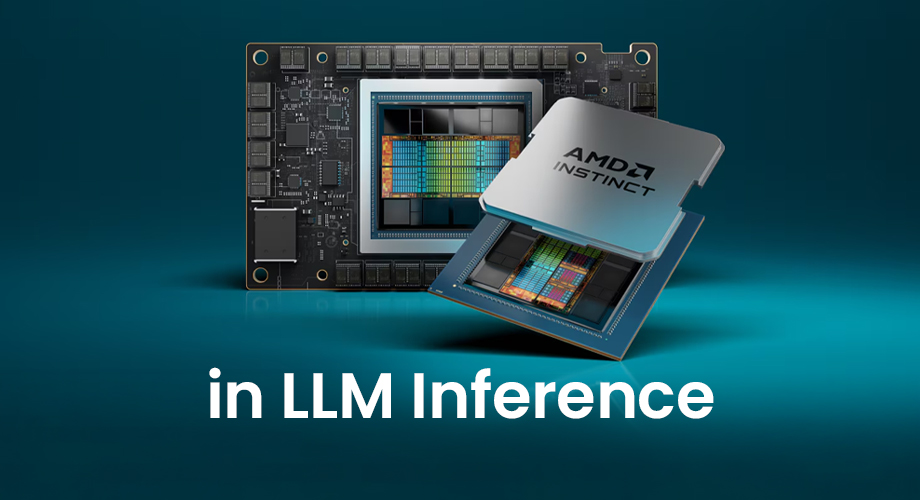
For modern AI inference, efficiency under load is the true measure of success. The results from AMD-DriveNets joint testing effort shows that the AMD Instinct MI355X is more than a list of high-end specs. It is a platform that converts heavy concurrency into usable throughput while keeping token latency bounded and predictable.
Learn more: How AMD Instinct Shines in Real-World LLM Inference

Lesson 4 – Optimizing GPU utilization
A rack of expensive GPUs shouldn’t just sit idle.
Yet a cluster can have plenty of processing power and still underperform. When operations wait on data moving across the network, available compute becomes idle compute. That can extend job completion times and weaken the economics of the entire deployment.
Evaluating AI infrastructure means considering the performance lost while GPUs wait. GPU utilization along with job completion time, and cost per million tokens can reveal whether the system is delivering.
Learn more: The most expensive idle asset in the world right now is a GPU waiting on the network

Lesson 5 – Moving faster
All-reduce takes the disparate vectors from multiple GPUs, adds them together, and distributes the combined result back to everyone.
Standard RCCL libraries typically execute this all-reduce operation using classic linear ring or tree topologies. This can introduce a synchronization challenge at LLM inference scale. Because data transfers happen sequentially, GPUs must wait for information to pass through the network before they can begin the next calculation.
For the end user, this means high latency and sluggish responses. Instead of getting answers faster, the system lags while the hardware struggles to coordinate, making the AI workload slower and more expensive to run.
We identify exactly where the software stack constrains the hardware for a specific use case and re-engineered that layer with precision, leveraging AMD-specific capabilities such as Infinity Fabric interconnect topology and ROCm-native kernel tuning. By doing so, DriveNets AI Fabric eliminates network bottlenecks and ensures the compute investment is never held back by the software surrounding it.
Learn more: Faster LLM Inference on AMD Requires Rethinking All-Reduce

While in Back to the Future, technology serves as a fantastic device for zipping through time, for the world of high performance networking, you need to consider how to best apply technology to deliver unmatched AI networking performance with faster deployment, complete hardware freedom, and seamless scalability across multi-tenant and multi-site environments.